Saturday, 20 February 2010

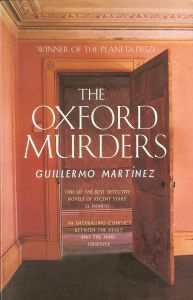
The Oxford Murders by Guillermo Martinez

This is one of the more unusual crime novels I have ever read.  Very briefly, it's about a serial killer who leaves mathematical clues as he proceeds on his killing spree.  I've included it here because it's set in Oxford and the author indulges in a considerable amount of place-name-dropping, and I suppose it does conjure up the rather rarefied air of a university.  It's translated from Spanish but, unlike some translations, you aren't aware of any awkwardness in the English.

It's a fast read by virtue of the fact that it's very short but I don't really think you'd call it a page-turner.  Its main appeal has to be the unusual link with mathematics.  That, however, floats cheerfully somewhere over my head, leaving me thinking, hmmm.

Saturday, 30 January 2010

Burning Bright by Tracy Chevalier

Tracy Chevalier's Burning Bright is the story of a family who moves from rural Dorset to London, where the father works for a circus.  They end up living next door to the poet and artist, William Blake.
If you know any of William Blake's poetry, it's likely to be "The Tiger":
Tiger, tiger, burning bright
In the forests of the night,
What immortal hand or eye
Could frame thy fearful symmetry?
Because of the title of the novel, you would be excused for thinking you were going to learn something about Blake, but in reality he is one of the minor characters.  The remaining characters lack much depth and are rather stereotypical, and the accents they are given are frankly irritating.  Country bumpkin versus Cockney. 

On the other hand, the book does portray London vividly and historically accurately. There is a real sense of place which may be just the thing to accompany a trip to the city.

Wednesday, 30 September 2009

The Book Thief by Markus Zusak


Apparently "The Book Thief" is classed as a young adult, even a children's book, in the USA, but it wasn't written as such and certainly I've thoroughly enjoyed it a very long way away from young adult years..

The story is set in wartime Germany and gives an insight into ordinary people's lives.  It is narrated by Death, which may sound morbid, but this Death is afraid of humans and wonders how they can be capable of so many glorious things as well as such ugliness.  And that really is one of the main themes of the book, along with death of course, the Second World War, and the conflict of ordinary people with the society they live in.

It's the story of Liesel, who has to be fostered when her own parents are taken away to a concentration camp for being Communists.  Her brother dies before they reach their foster parents and she steals a book, a grave digger's manual, even though at that time she couldn't read.  It's the story of the books that pass through her hands, and the story of how she survives the events of the war.

There isn't, in truth, a great sense of place, but there most certainly is an all-enveloping feeling of being immersed in the time.  This is such an important part of Germany's history, I would happily recommend the book to anyone planning to visit Germany.

Tuesday, 16 June 2009

White Tiger by Aravind Adiga


An eye-opening story set in modern India, a country of start contrasts between rich and poor, between the Light and the Darkness, between men with fat bellies and men with thin bellies.  It's a rapid and easy read - cynical, provocative, and entertaining.

The format of the book is a series of emails sent by the narrator to a Chinese head of state due to visit India, to explain the truth about being an Indian entrepreneur.  In essence, it's a very moral tale, it exposes corruption in all its forms, the extraordinary poverty in an upwardly mobile society, the blurred moral boundaries.  In spite of it all, I have a lingering sympathy for Balram.


In India, 76% live below the poverty limit of $2 a day, compared to 73% in Sub-Saharan Africa.  People forget this, probably because there is the "new" India, the world of technology and entrepreneurs, the world that Balram wants to join.  It is this contrast that is brought out so very well in the book.
The dreams of the rich and the dreams of the poor - they never overlap, do they?
See, the poor dream all their lives of getting enough to eat and looking like the rich. And what do the rich dream of?  Losing weight and looking like the poor.

Reblog this post [with Zemanta]

Monday, 1 June 2009

Extra Virgin by Annie Hawes


A very enjoyable read, but it didn't flow very smoothly, nor was it a page turner.  I thought the descriptions of local people and life in the village very interesting and not too patronising or over-romanticised as so many are in this type of book.  In my view it was much better than Under the Tuscan Sun which had a very self-satisfied tone that I didn't like.

I would have liked more information about Annie and her sister - it was a bit of a mystery how they transformed from holiday workers on the rose farm into part-time residents, or did I miss something?  What did they do in England and how were they able to travel back and forth so often?  I imagine the reason was to maintain some privacy, but it bothered me somehow.

The structure seemed to me to be a little odd. At first I thought it was going to be a description of a single year, only to realise that it was progressing through the years as well as the seasons. At times that gave a confusing/disjointed impression and it made it hard to follow in places.

Nevertheless it was a very entertaining read and one I would recommend to anyone interested in Italy.
Reblog this post [with Zemanta]

Saturday, 25 April 2009

The Girl with the Dragon Tattoo by Stieg Larsson


 This book is an excellent crime novel set in Sweden. I have read a number of Henning Mankell's novels but this is very different. It's a gripping and fast read, a little graphically brutal here and there, though not excessively.  By that I mean I was able to skim over those parts, enough to realise what was happening but not enough to give me nightmares!  The translation is excellent in that you truly aren't aware that that the book wasn't originally written in English.  That's not often the case, sadly.

I enjoyed the picture it gave of Swedish life, in particular rural and island life.  I have a firm picture of  Hedeby, picturesque villages and summer cabins, so unlike the melancholy and brooding of Mankell's Sweden.

Thursday, 19 February 2009

Paris in the Fifties by Stanley Karnow


This book is neither about Paris nor set in the fifties, for the most part.  I rarely consider giving up on a book, but in the first few chapters, I was sorely tempted.  It seemed to be nothing but a recital of all the celebrities and intellectuals that Stanley Karnow had met during his time as a foreign correspondent in Paris.

I'm really glad I didn't put it down though, because it improved immeasurably after those first chapters.  Most of the paragraphs have a theme, such as the history of the guillotine, Ho Chi Minh and Vietnam, Algeria, and as a whole gives an interesting and readable view of France and French culture.